Ridian
Helps everyday investors get exposure to crypto through automated, non-custodial portfolio products. As senior product designer, I designed the end-to-end V1 consumer experience, working alongside product manager, quant trader and founding engineering team.
Role
Senior Product Designer
Industry
Crypto Fintech · B2C
status
Shipped
Year
2022-2023
overview
Ridian connects to users' existing exchange accounts via API and automates investment across portfolio products: Bitcoin, diversified top-5 crypto, and others based on a user-defined allocation.
The platform is non-custodial. It operates on exchange accounts users already own, which shaped every design decision from onboarding through portfolio management.

Problem
Novice crypto investors want exposure to the market without making daily trading decisions. Research with beta users confirmed the pattern: most users wanted general portfolio exposure and had no interest in actively managing their holdings. The existing solutions were either trading directly on exchanges, hiring a fund manager, or doing nothing. This left the gap Ridian was built to fill.
The core design constraint was trust under a non-custodial model. Asking a first-time crypto investor to share API keys to their exchange account without Ridian holding their actual funds required the onboarding to feel both honest about what was happening and reassuring that it was safe.

Early discovery experience + journey mapping
process
The V1 design started with a UX audit of the beta product, one-on-one user interviews and internal dogfooding, a quantitative survey, competitive analysis across ten products in the space (Ember Fund, Stoic, Stacked Invest, MatrixPort, Domain Money, and others), and experience mapping.
design decisions shaped the product.
Partial allocation, not all-in. Early product thinking required users to commit their full exchange balance to Ridian. The design recommendation was partial allocation. Users invest a portion of their existing balance, not all of it. The rationale was straightforward: beginner investors want to test with smaller amounts before committing more. The fund allocation screen became one of the most complex surfaces in the product, showing user's live exchange balance, letting them select which assets to include, and setting per-asset allocation percentages.
Don't force users cash-out of existing positions. The platform works around existing holdings, and the UI communicates clearly when a user's manual exchange trade affects their Ridian portfolio.
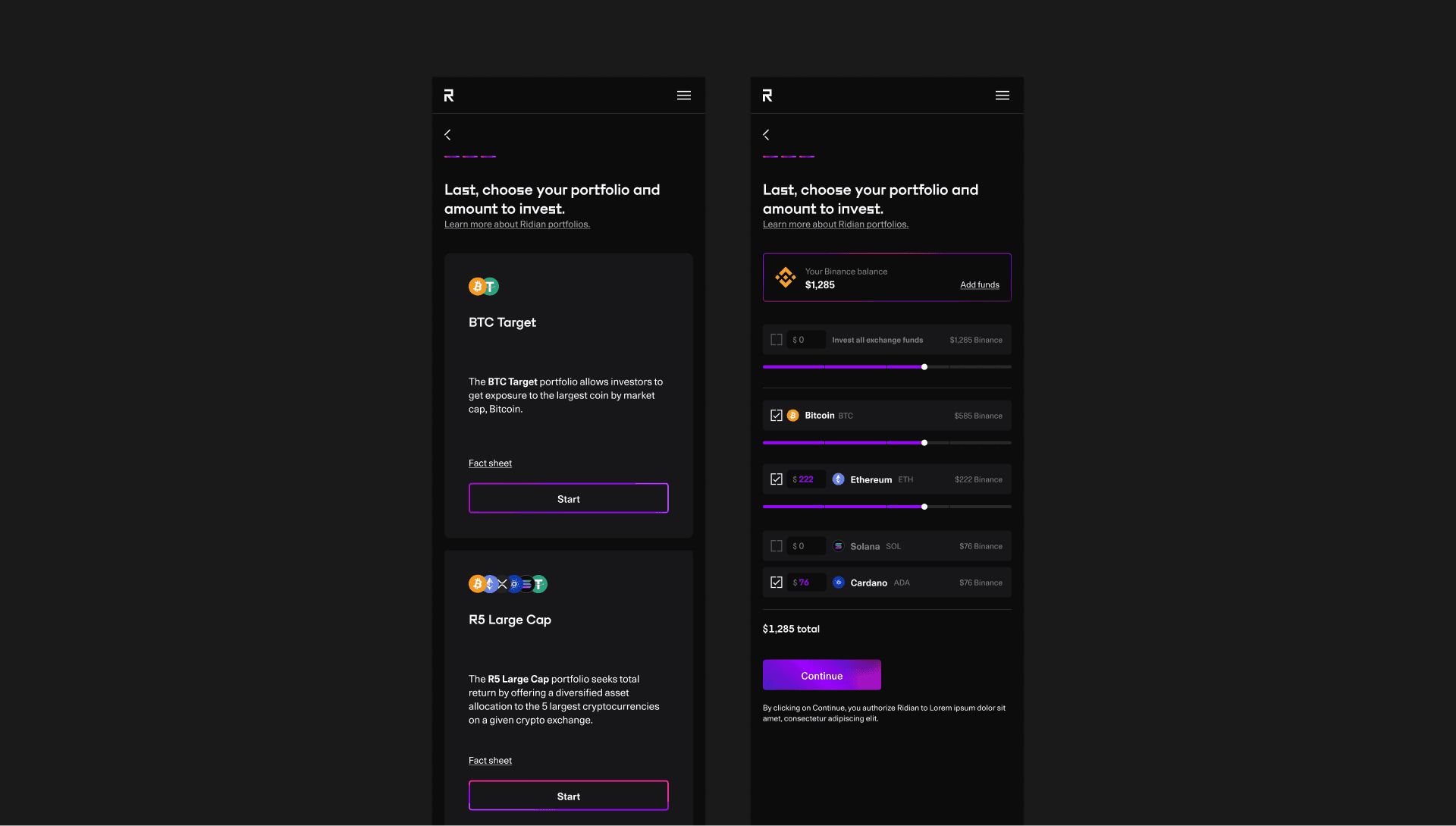
Portfolio selection and fund allocation mobile screens for responsive mobile web app

A single dynamic banner component serves as the system's communication layer, handling success states, error conditions, and proactive notices.
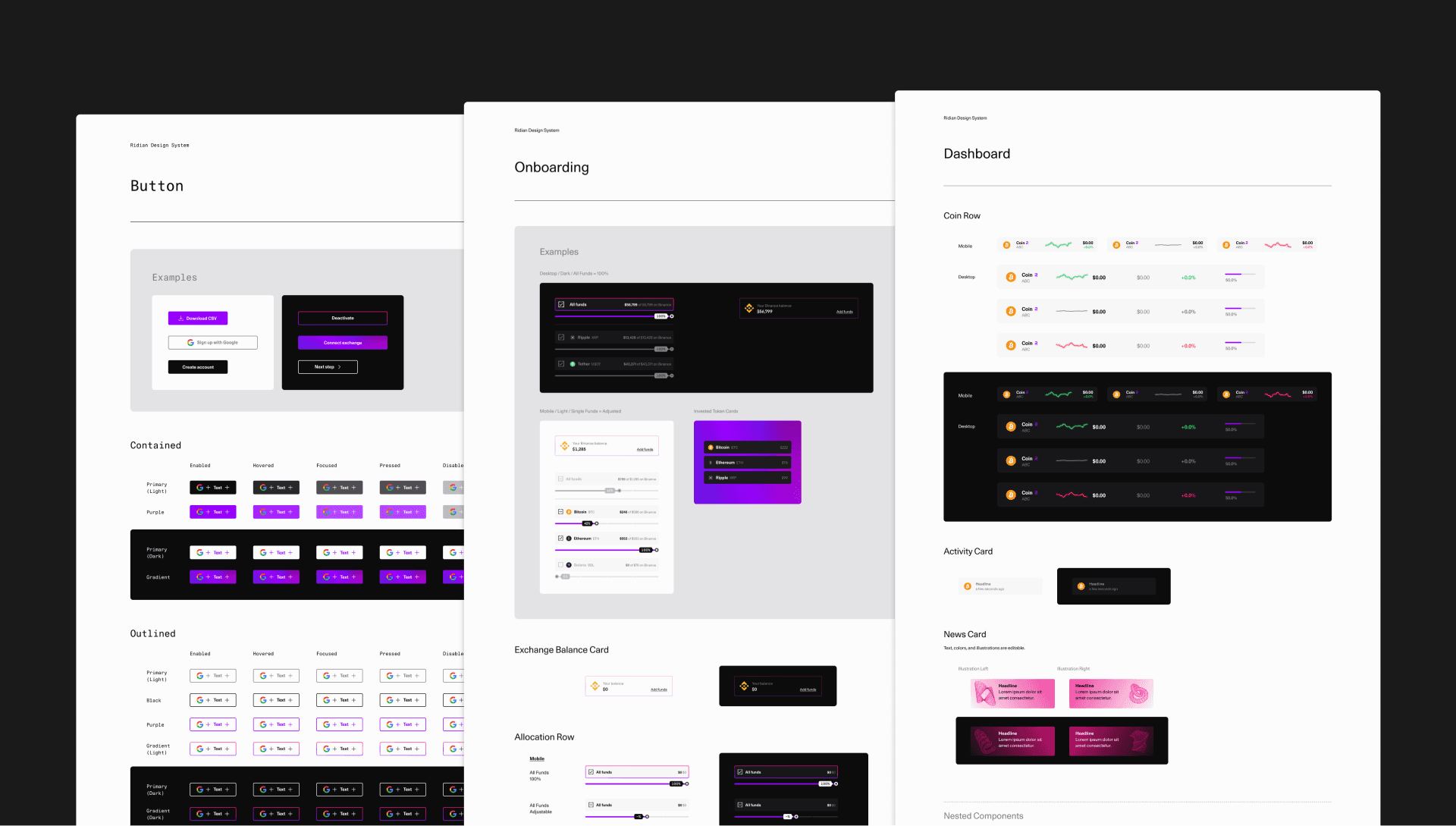
Ridian design system
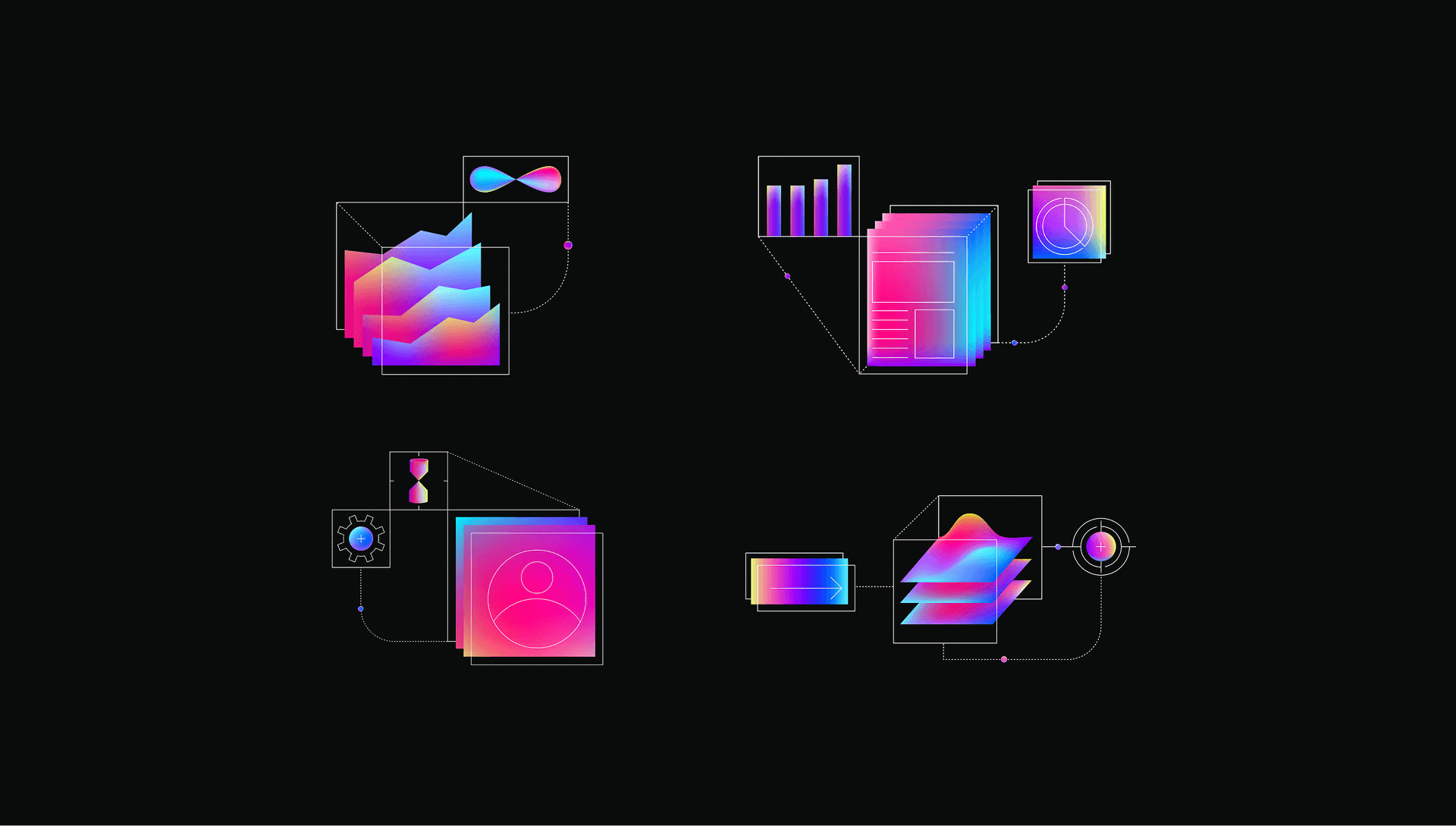
Ridian's design system was built from scratch alongside the V1 product. The visual language centers on a custom typeface (Ridian Cubic), a neon gradient palette on dark backgrounds, and a technical illustration system assembled from geometric primitives — lines, nodes, circle, square add-ons, and gradient shapes.
Brand direction
The visual identity was built to feel premium and approachable. The brand voice was a straight-talking analyst: clear and direct.
A custom typeface (Ridian Cubic), a neon gradient palette (violet, cyan, lime, pink on black), an illustration system built from geometric primitives and gradient shapes, and an 18×18 icon grid make up the full identity.

18x18 square grid to ensure a unified icon design

System icon design


Ridian
Helps everyday investors get exposure to crypto through automated, non-custodial portfolio products. As senior product designer, I designed the end-to-end V1 consumer experience, working alongside product manager, quant trader and founding engineering team.

overview
I joined as employee #2 and provided design consultation at angel stage, working alongside co-founders Paul Hsiao (ex VC) and Ryan Bubinski (co-founder of Codecademy).
I designed the 0-to-1 product foundation and worked on early brand direction. The early beta product contributed to a successful $4M seed round.
Role
Senior Product Designer
Industry
Crypto Fintech · B2C
status
Shipped
Year
2022-2023
Problem
Novice crypto investors want exposure to the market without making daily trading decisions. Research with beta users confirmed the pattern: most users wanted general portfolio exposure and had no interest in actively managing their holdings. The existing solutions were either trading directly on exchanges, hiring a fund manager, or doing nothing. This left the gap Ridian was built to fill.
The core design constraint was trust under a non-custodial model. Asking a first-time crypto investor to share API keys to their exchange account without Ridian holding their actual funds required the onboarding to feel both honest about what was happening and reassuring that it was safe.
Token Comparison AI feature for SEC Demo
Early discovery experience + journey mapping
Founders validated the problem through 100+ direct conversations with enterprise software buyers (CIOs, CTOs, and CPOs) at companies including Gucci, US Bank, Duolingo, and Carvana.
The pattern was consistent across all of them: Gartner has credibility but costs $30,000 per seat and updates annually. G2 reviews are widely considered gamed. Nothing neutral, current, and structured exists for buyers evaluating AI software.
design decisions shaped the product.
Partial allocation, not all-in. Early product thinking required users to commit their full exchange balance to Ridian. The design recommendation was partial allocation. Users invest a portion of their existing balance, not all of it. The rationale was straightforward: beginner investors want to test with smaller amounts before committing more. The fund allocation screen became one of the most complex surfaces in the product, showing user's live exchange balance, letting them select which assets to include, and setting per-asset allocation percentages.
Don't force users cash-out of existing positions. The platform works around existing holdings, and the UI communicates clearly when a user's manual exchange trade affects their Ridian portfolio.
Enterprise software buying is structurally broken on both sides. Buyers struggle to write requirements, find the right vendors, trust the reviews they find, and get stakeholder buy-in while managing a process that spans requirements definition, vendor evaluation, proof of concept, and negotiation simultaneously.
Vendors struggle to reach the right prospects, get listed on analyst rankings, and understand why they win or lose deals. Existing tools address individual symptoms; none address the full workflow for either side.
In AI software specifically where new categories emerge every few months, annual analyst research cycles are structurally inadequate and slow.
process
The V1 design started with a UX audit of the beta product, one-on-one user interviews and internal dogfooding, a quantitative survey, competitive analysis across ten products in the space (Ember Fund, Stoic, Stacked Invest, MatrixPort, Domain Money, and others), and experience mapping.
Token Comparison AI feature for SEC Demo
Portfolio selection and fund allocation mobile screens for responsive mobile web app
A single dynamic banner component serves as the system's communication layer, handling success states, error conditions, and proactive notices.
Ridian design system
Ridian's design system was built from scratch alongside the V1 product. The visual language centers on a custom typeface (Ridian Cubic), a neon gradient palette on dark backgrounds, and a technical illustration system assembled from geometric primitives — lines, nodes, circle, square add-ons, and gradient shapes.
AI-first entry point A single prompt surfaces the core jobs the platform does: search products, generate requirements, find experts, and explore markets.
18x18 square grid to ensure a unified icon design
System icon design
Brand direction
The visual identity was built to feel premium and approachable. The brand voice was a straight-talking analyst: clear and direct.
A custom typeface (Ridian Cubic), a neon gradient palette (violet, cyan, lime, pink on black), an illustration system built from geometric primitives and gradient shapes, and an 18×18 icon grid make up the full identity.
Ridian
Helps everyday investors get exposure to crypto through automated, non-custodial portfolio products. As senior product designer, I designed the end-to-end V1 consumer experience, working alongside product manager, quant trader and founding engineering team.
Role
Senior Product Designer
Industry
Crypto Fintech · B2C
status
Shipped
Year
2022-2023
I joined as employee #2 and provided design consultation at angel stage, working alongside co-founders Paul Hsiao (ex VC) and Ryan Bubinski (co-founder of Codecademy).
I designed the 0-to-1 product foundation and worked on early brand direction. The early beta product contributed to a successful $4M seed round.
overview
Airframe is positioned against the incumbent analyst firms such as Gartner, Forrester, IDC that enterprise software buyers have relied on for decades.
These companies publish annual reports, cover roughly 200 software categories, and charge $30,000 per seat. Airframe uses AI agents and a network of practitioners to cover 2,000 categories, updated monthly.
Novice crypto investors want exposure to the market without making daily trading decisions. Research with beta users confirmed the pattern: most users wanted general portfolio exposure and had no interest in actively managing their holdings. The existing solutions were either trading directly on exchanges, hiring a fund manager, or doing nothing. This left the gap Ridian was built to fill.
Problem
The core design constraint was trust under a non-custodial model. Asking a first-time crypto investor to share API keys to their exchange account without Ridian holding their actual funds required the onboarding to feel both honest about what was happening and reassuring that it was safe.
Don't force users cash-out of existing positions. The platform works around existing holdings, and the UI communicates clearly when a user's manual exchange trade affects their Ridian portfolio.
process
The V1 design started with a UX audit of the beta product, one-on-one user interviews and internal dogfooding, a quantitative survey, competitive analysis across ten products in the space (Ember Fund, Stoic, Stacked Invest, MatrixPort, Domain Money, and others), and experience mapping.
design decisions shaped the product.
Partial allocation, not all-in. Early product thinking required users to commit their full exchange balance to Ridian. The design recommendation was partial allocation. Users invest a portion of their existing balance, not all of it. The rationale was straightforward: beginner investors want to test with smaller amounts before committing more. The fund allocation screen became one of the most complex surfaces in the product, showing user's live exchange balance, letting them select which assets to include, and setting per-asset allocation percentages.
Token Comparison AI feature for SEC Demo
Early discovery experience + journey mapping
Portfolio selection and fund allocation mobile screens for responsive mobile web app
A single dynamic banner component serves as the system's communication layer, handling success states, error conditions, and proactive notices.
Ridian design system
Ridian's design system was built from scratch alongside the V1 product. The visual language centers on a custom typeface (Ridian Cubic), a neon gradient palette on dark backgrounds, and a technical illustration system assembled from geometric primitives — lines, nodes, circle, square add-ons, and gradient shapes.
Brand direction
The visual identity was built to feel premium and approachable. The brand voice was a straight-talking analyst: clear and direct.
A custom typeface (Ridian Cubic), a neon gradient palette (violet, cyan, lime, pink on black), an illustration system built from geometric primitives and gradient shapes, and an 18×18 icon grid make up the full identity.
18x18 square grid to ensure a unified icon design
System icon design