Airframe AI
AI-native decision intelligence platform that helps enterprise teams research, evaluate, and procure software.
Role
Founding Designer
Industry
AI · B2B
status
Shipped
Year
2024-2025
overview
I joined as employee #2 and provided design consultation at angel stage, working alongside co-founders Paul Hsiao (ex VC) and Ryan Bubinski (co-founder of Codecademy).
I designed the 0-to-1 product foundation and worked on early brand direction. The early beta product contributed to a successful $4M seed round.
Airframe is positioned against the incumbent analyst firms such as Gartner, Forrester, IDC that enterprise software buyers have relied on for decades.
These companies publish annual reports, cover roughly 200 software categories, and charge $30,000 per seat. Airframe uses AI agents and a network of practitioners to cover 2,000 categories, updated monthly.
Problem
The full product vision is a full-stack software research platform covering research and category guides, RFP management, vendor shortlisting, RFP process orchestration, AI agent benchmarking, and an expert network , connected by AI agents across all surfaces. The long-term scale is 500 AI categories, 25,000 vendors, and 1 million software experts.
The beta MVP covers the first five stages.


Conversations with enterprise buyers confirmed the same pattern: Existing tools were too expensive, too slow, or too gamed to trust.
Founders validated the problem through 100+ direct conversations with enterprise software buyers (CIOs, CTOs, and CPOs) at companies including Gucci, US Bank, Duolingo, and Carvana.
The pattern was consistent across all of them: Gartner has credibility but costs $30,000 per seat and updates annually. G2 reviews are widely considered gamed. Nothing neutral, current, and structured exists for buyers evaluating AI software.
Enterprise software buying is structurally broken on both sides. Buyers struggle to write requirements, find the right vendors, trust the reviews they find, and get stakeholder buy-in while managing a process that spans requirements definition, vendor evaluation, proof of concept, and negotiation simultaneously.
Vendors struggle to reach the right prospects, get listed on analyst rankings, and understand why they win or lose deals. Existing tools address individual symptoms; none address the full workflow for either side.
In AI software specifically where new categories emerge every few months, annual analyst research cycles are structurally inadequate and slow.
process
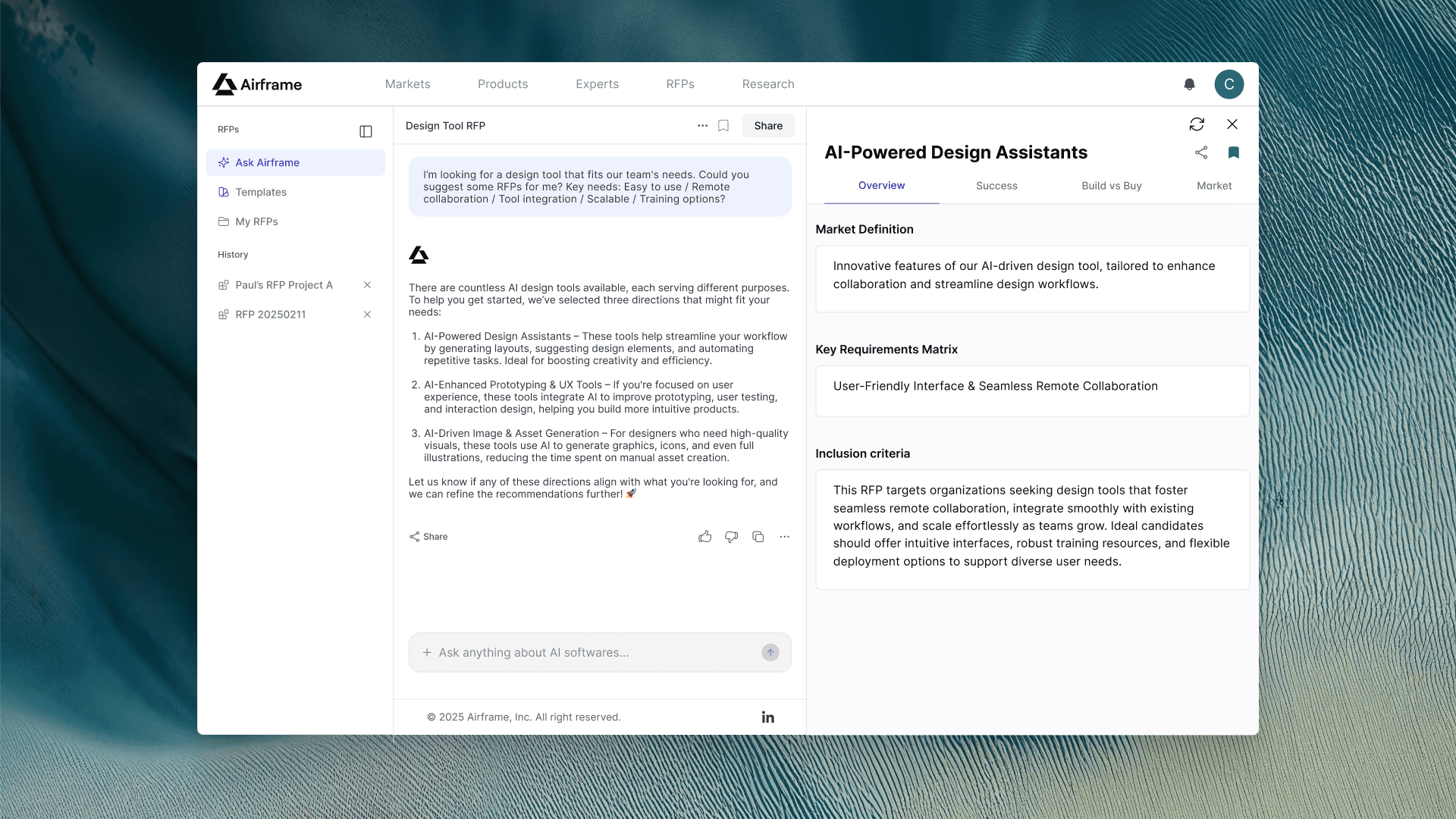
The product covers 5 distinct jobs-to-be-done: Market Research, Vendor Discovery, Community Intelligence, RFP Management, and AI-assisted Guidance. The core design challenge was making those five products feel like one product journey rather than five tools with shared navigation.
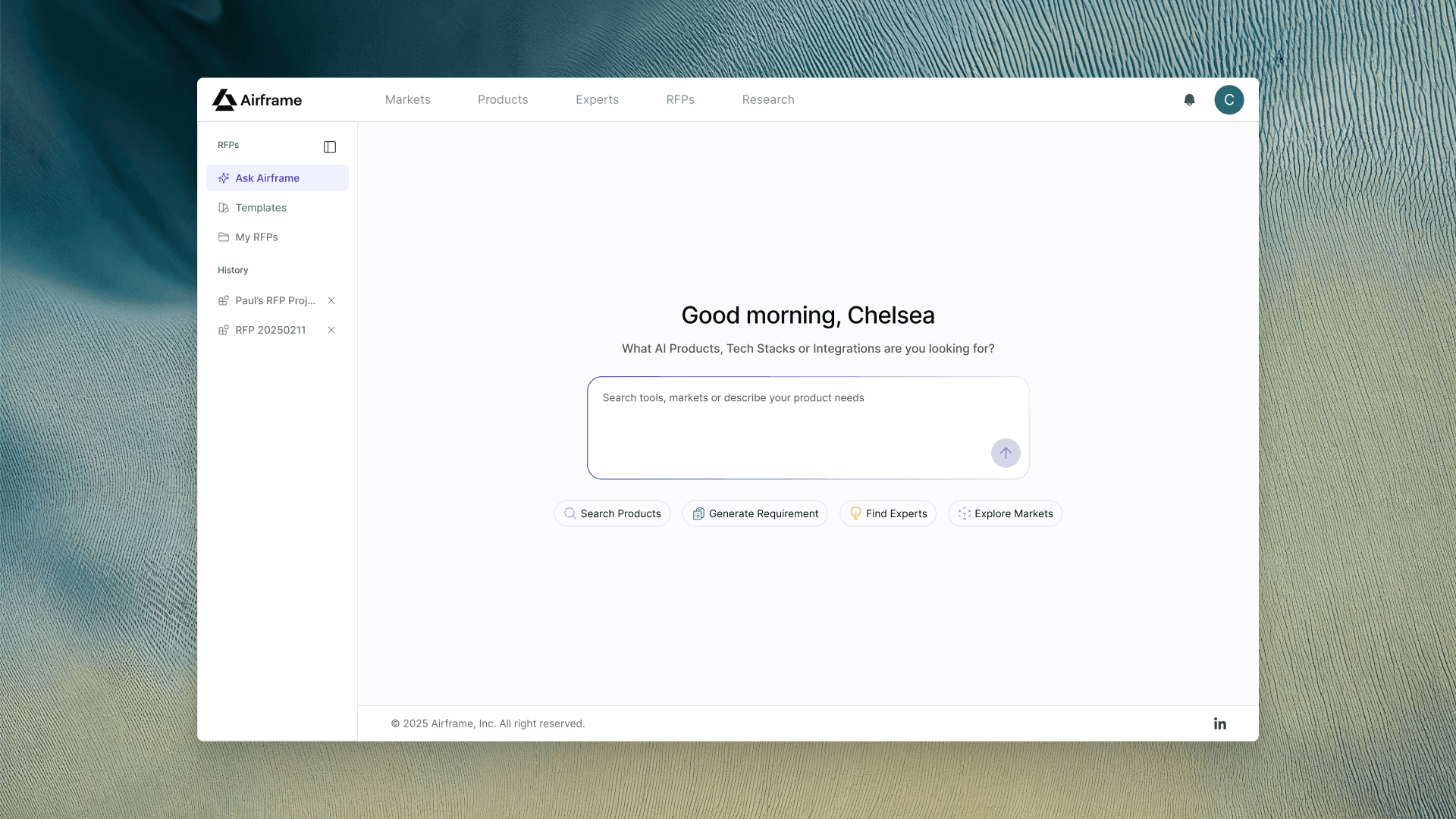
AI-first entry point A single prompt surfaces the core jobs the platform does: search products, generate requirements, find experts, and explore markets.

Expert lists their active software stack alongside their expertise so buyers can find someone who has actually used the tool they're evaluating

Procurement workflow maps directly to how enterprise buyers actually buy
RFP workflow
The most structurally complex surface is the RFP module. Designing this surface meant resisting the temptation to simplify, a 3-tab version would feel cleaner but would break the workflow at the point where buyers most need structure. The stepper makes complex journey visible without requiring the user to hold it in their head.

Anonymous Peer Q&A
The community Q&A is built around one insight from the research: buyers don't trust public reviews, but they do trust a peer who's actually used the tool. Each question routes to practitioners with relevant context, company size, industry, active software stack so that the answer comes from someone whose situation matches the buyer's.

Brand direction
The brand sits between professional B2B SaaS and AI-native product. It is more premium than a typical public review site like Product Hunt. The visual language needed to feel trustworthy to the target enterprise audience before it felt innovative. Clean sans-serif type, a restrained blue/indigo accent, and a geometric mark were the outputs of some of the branding work.


Airframe AI
AI-native decision intelligence platform that helps enterprise teams research, evaluate, and procure software.

overview
I joined as employee #2 and provided design consultation at angel stage, working alongside co-founders Paul Hsiao (ex VC) and Ryan Bubinski (co-founder of Codecademy).
I designed the 0-to-1 product foundation and worked on early brand direction. The early beta product contributed to a successful $4M seed round.
Airframe is positioned against the incumbent analyst firms such as Gartner, Forrester, IDC that enterprise software buyers have relied on for decades.
These companies publish annual reports, cover roughly 200 software categories, and charge $30,000 per seat. Airframe uses AI agents and a network of practitioners to cover 2,000 categories, updated monthly.
Role
Founding Designer
Industry
AI · B2B
status
Shipped
Year
2024-2025
Problem
The full product vision is a full-stack software research platform covering research and category guides, RFP management, vendor shortlisting, RFP process orchestration, AI agent benchmarking, and an expert network , connected by AI agents across all surfaces. The long-term scale is 500 AI categories,
25,000 vendors, and 1 million software experts.
The beta MVP covers the first five stages.
Token Comparison AI feature for SEC Demo
Conversations with enterprise buyers confirmed the same pattern: Existing tools were too expensive, too slow, or too gamed to trust.
Founders validated the problem through 100+ direct conversations with enterprise software buyers (CIOs, CTOs, and CPOs) at companies including Gucci, US Bank, Duolingo, and Carvana.
The pattern was consistent across all of them: Gartner has credibility but costs $30,000 per seat and updates annually. G2 reviews are widely considered gamed. Nothing neutral, current, and structured exists for buyers evaluating AI software.
Enterprise software buying is structurally broken on both sides. Buyers struggle to write requirements, find the right vendors, trust the reviews they find, and get stakeholder buy-in while managing a process that spans requirements definition, vendor evaluation, proof of concept, and negotiation simultaneously.
Vendors struggle to reach the right prospects, get listed on analyst rankings, and understand why they win or lose deals. Existing tools address individual symptoms; none address the full workflow for either side.
In AI software specifically where new categories emerge every few months, annual analyst research cycles are structurally inadequate and slow.
process
The product covers 5 distinct jobs-to-be-done: Market Research, Vendor Discovery, Community Intelligence, RFP Management, and AI-assisted Guidance. The core design challenge was making those five products feel like one product journey rather than five tools with shared navigation.
Token Comparison AI feature for SEC Demo
AI-first entry point A single prompt surfaces the core jobs the platform does: search products, generate requirements, find experts, and explore markets.
Expert lists their active software stack alongside their expertise so buyers can find someone who has actually used the tool they're evaluating
Procurement workflow maps directly to how enterprise buyers actually buy
RFP workflow
The most structurally complex surface is the RFP module. Designing this surface meant resisting the temptation to simplify, a 3-tab version would feel cleaner but would break the workflow at the point where buyers most need structure. The stepper makes complex journey visible without requiring the user to hold it in their head.
Anonymous Peer Q&A
The community Q&A is built around one insight from the research: buyers don't trust public reviews, but they do trust a peer who's actually used the tool. Each question routes to practitioners with relevant context, company size, industry, active software stack so that the answer comes from someone whose situation matches the buyer's.
AI-first entry point A single prompt surfaces the core jobs the platform does: search products, generate requirements, find experts, and explore markets.
Brand direction
The brand sits between professional B2B SaaS and AI-native product. It is more premium than a typical public review site like Product Hunt. The visual language needed to feel trustworthy to the target enterprise audience before it felt innovative. Clean sans-serif type, a restrained blue/indigo accent, and a geometric mark were the outputs of some of the branding work.
Airframe AI
AI-native decision intelligence platform that helps enterprise teams research, evaluate, and procure software.
Role
Founding Designer
Industry
AI · B2B
status
Shipped
Year
2024-2025
I joined as employee #2 and provided design consultation at angel stage, working alongside co-founders Paul Hsiao (ex VC) and Ryan Bubinski (co-founder of Codecademy).
I designed the 0-to-1 product foundation and worked on early brand direction. The early beta product contributed to a successful $4M seed round.
overview
Airframe is positioned against the incumbent analyst firms such as Gartner, Forrester, IDC that enterprise software buyers have relied on for decades.
These companies publish annual reports, cover roughly 200 software categories, and charge $30,000 per seat. Airframe uses AI agents and a network of practitioners to cover 2,000 categories, updated monthly.
Problem
The full product vision is a full-stack software research platform covering research and category guides, RFP management, vendor shortlisting, RFP process orchestration, AI agent benchmarking, and an expert network , connected by AI agents across all surfaces. The long-term scale is 500 AI categories,
25,000 vendors, and 1 million software experts.
The beta MVP covers the first five stages.
Founders validated the problem through 100+ direct conversations with enterprise software buyers (CIOs, CTOs, and CPOs) at companies including Gucci, US Bank, Duolingo, and Carvana.
The pattern was consistent across all of them: Gartner has credibility but costs $30,000 per seat and updates annually. G2 reviews are widely considered gamed. Nothing neutral, current, and structured exists for buyers evaluating AI software.
Founders validated the problem through 100+ direct conversations with enterprise software buyers (CIOs, CTOs, and CPOs) at companies including Gucci, US Bank, Duolingo, and Carvana.
Enterprise software buying is structurally broken on both sides. Buyers struggle to write requirements, find the right vendors, trust the reviews they find, and get stakeholder buy-in while managing a process that spans requirements definition, vendor evaluation, proof of concept, and negotiation simultaneously.
Vendors struggle to reach the right prospects, get listed on analyst rankings, and understand why they win or lose deals. Existing tools address individual symptoms; none address the full workflow for either side.
In AI software specifically where new categories emerge every few months, annual analyst research cycles are structurally inadequate and slow.
process
The product covers 5 distinct jobs-to-be-done: Market Research, Vendor Discovery, Community Intelligence, RFP Management, and AI-assisted Guidance. The core design challenge was making those five products feel like one product journey rather than five tools with shared navigation.
Token Comparison AI feature for SEC Demo
Conversations with enterprise buyers confirmed the same pattern: Existing tools were too expensive, too slow, or too gamed to trust.
AI-first entry point A single prompt surfaces the core jobs the platform does: search products, generate requirements, find experts, and explore markets.
Expert lists their active software stack alongside their expertise so buyers can find someone who has actually used the tool they're evaluating
Procurement workflow maps directly to how enterprise buyers actually buy
RFP workflow
The most structurally complex surface is the RFP module. Designing this surface meant resisting the temptation to simplify, a 3-tab version would feel cleaner but would break the workflow at the point where buyers most need structure. The stepper makes complex journey visible without requiring the user to hold it in their head.
Anonymous Peer Q&A
The community Q&A is built around one insight from the research: buyers don't trust public reviews, but they do trust a peer who's actually used the tool. Each question routes to practitioners with relevant context, company size, industry, active software stack so that the answer comes from someone whose situation matches the buyer's.
Brand direction
The brand sits between professional B2B SaaS and AI-native product. It is more premium than a typical public review site like Product Hunt. The visual language needed to feel trustworthy to the target enterprise audience before it felt innovative. Clean sans-serif type, a restrained blue/indigo accent, and a geometric mark were the outputs of some of the branding work.